Archive

Colombia, then.
Colombia, now.

Mule-drawn trams on dirt streets. A civil war recruitment line in the plaza where tourists now pose with llamas. A cathedral that took 56 years to finish. The photos that show how fast this country changed, and the people who pushed it.

Archive photographs, public domain · 1853 to 2026

Most visitors see Colombia as new. It is not new. It is one of the oldest continuously inhabited corners of the Americas, and the proof is in the pictures.

A note before you scroll

The Country, Twice.

Eight places. Same frame, different century. The cities in these pictures are still there. You can walk to them this afternoon.

1910 Muelle de los Pegasos and Torre del Reloj, Cartagena, 1910
Today Cartagena walled city today
Cartagena · Torre del Reloj

The only way in.

For nearly three centuries the Torre del Reloj was the single land entrance into the walled city. The clock itself is Swiss, installed in 1874, and still runs. Around it in this 1910 photo you see the wooden skiffs and stone dock that handled most of the commerce, because the railroad to the interior did not exist yet. Everything moved by water or mule.

Then: anonymous postcard, public domain · Now: modern Cartagena, Unsplash
1884 Mule-drawn tram on Bogotá's Calle Real, 1884
Today Carrera Séptima, Bogotá today
Bogotá · Carrera Séptima

Mules, then riots, then nothing.

Bogotá's first public transit was a tram pulled by mules, opened in 1884 along what is now Carrera Séptima. It went electric in 1910. Then came April 9, 1948. Rioters burned every tram in the city during the Bogotazo and the system was never rebuilt. Bogotá went 52 years without mass transit until TransMilenio opened in 2000. The metro arrives in 2027.

Then: unknown photographer, public domain · Now: Bogotá skyline, Unsplash
1900 Military recruiting in Plaza de Bolívar, 1900
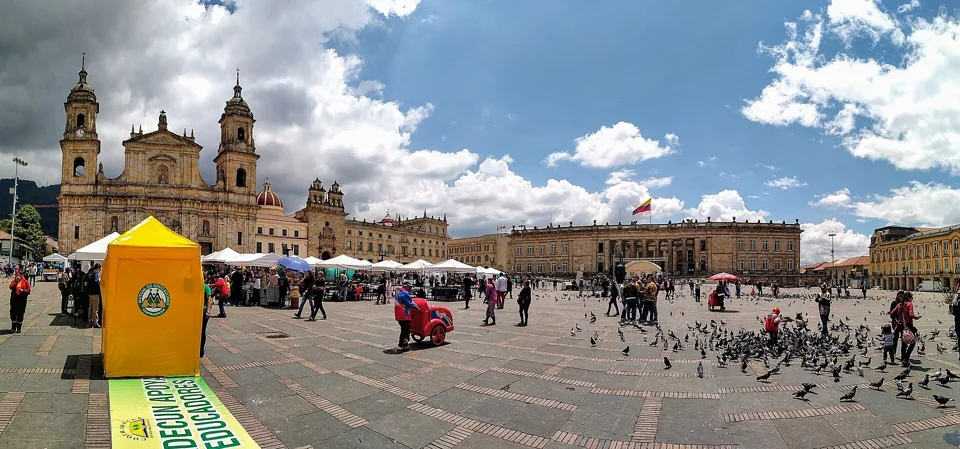
Today Plaza de Bolívar today
Bogotá · Plaza de Bolívar

A civil war, in the plaza.

This is the Thousand Days' War, mid-recruitment. Liberal and Conservative armies pulled men into Plaza de Bolívar to fight a conflict that killed around 100,000 Colombians and left the country so weakened that the United States orchestrated Panama's secession three years later. The same square today hosts weekend tourists, llamas in knit hats, and pigeons.

Then: from Carlos E. Jaramillo, La guerra de los mil días, public domain · Now: Plaza de Bolívar, Unsplash
c. 1900 Procesión del Santo Sepulcro, Parque Berrío, Medellín, 1900
Today Parque Berrío, Medellín, 2024
Medellín · Parque Berrío

Meet the man who photographed paisa Medellín.

Melitón Rodríguez ran a Medellín studio that shot over 80,000 negatives of paisa life from 1892 onward, making him Colombia's most important documentary photographer of the period. This Holy Week procession fills Parque Berrío, which today is ringed by bank towers and sits directly above a Metro station. The cathedral in the background is still standing.

Then: Melitón Rodríguez, public domain · Now: modern Medellín valley, Unsplash
c. 1900-1920 Medellín Metropolitan Cathedral under construction
Today Catedral Metropolitana de Medellín today
Medellín · Catedral Basílica Metropolitana

1.12 million bricks. Fifty-six years.

The Catedral Basílica Metropolitana took 56 years to build, from 1875 to 1931, and required an estimated 1.12 million handmade bricks, making it one of the largest brick buildings in Latin America. Its French architect Charles Carré died decades before it was finished. It still anchors Parque Bolívar in downtown Medellín.

Then: unknown photographer, public domain · Now: Medellín, Unsplash
April 9, 1948 Tram burning in front of the Capitolio during El Bogotazo, 1948
Today Bogotá today
Bogotá · El Bogotazo

The day Bogotá burned.

Populist presidential candidate Jorge Eliécer Gaitán was shot on a Bogotá sidewalk at 1:05 p.m. on April 9, 1948. Within hours rioters had killed his assassin, burned the trams, and destroyed much of downtown. Fidel Castro, then a 21-year-old law student in Bogotá for a conference, was caught up in it and later cited it as formative. The violence kicked off a decade called simply La Violencia that killed 200,000 Colombians.

Then: Daniel Pradilla Holguín, Biblioteca Luis Ángel Arango, CC BY-SA 3.0 · Now: Bogotá, Unsplash
early 1900s Salto del Tequendama postcard, early 1900s
Today Salto del Tequendama today
Cundinamarca · Salto del Tequendama

A sacred waterfall, then a warning.

The 132-meter Tequendama Falls were a pilgrimage site for the Muisca, who believed the deity Bochica split the rock to drain a sacred lake. By the 2000s the Bogotá River above it was so polluted the falls had become a symbol of environmental collapse. A cleanup starting in 2017 has slowly brought the river back, and the haunted old Hotel del Salto on the cliff edge is now the Museo Tequendama.

Then: Flohr, Price & Co. postcard, Biblioteca Luis Ángel Arango, public domain · Now: Andean cloud forest, Unsplash
1884 Magdalena River steamboat illustration, 1884
Today Colombian coast today
Magdalena River · Steamboat era

Weeks of river, then the mules.

Before the railroads and highways, the only route from the coast to Bogotá was a multi-week journey up the Magdalena River by steamboat, followed by mule up the Andes. Gabriel García Márquez's Love in the Time of Cholera climaxes on one of these boats. By the 1960s the steamboats were gone, replaced first by pipelines and then by highways that still cannot quite match the river's reach.

Then: illustration from América Pintoresca, 1884, public domain · Now: Colombian Caribbean, Unsplash
2002 Comuna 13 electric escalators, Medellín
Today Graffiti in Comuna 13, Medellín, today
Medellín · Comuna 13

Most violent neighborhood, most famous escalators.

Comuna 13 was the most violent neighborhood in the most violent city in the world in the late 1990s. In October 2002 the Colombian army launched Operation Orión, a raid with roughly 1,000 soldiers and eight helicopters against guerrilla and paramilitary groups. Nine years later the city installed 384 meters of outdoor escalators up the hillside, cutting a 35-minute climb down to 6 minutes. It is now one of the most visited spots in Medellín.

Escalators: Juan Gómez via Flickr, CC BY 2.0 · Now: hillside Medellín, Unsplash

The People Who Built It.

Colombia was argued into existence by a handful of stubborn, sometimes fatal, personalities. Here are five you will see referenced everywhere, from street names to airport terminals to novels. Worth knowing before you land.

Simón Bolívar, portrait by Luis Toro Moreno
1783 · 1830 · El Libertador
Simón Bolívar
Soldier, statesman, founder of Gran Colombia

Born in Caracas, educated in Madrid, Bolívar led the military campaigns that freed six countries from Spanish rule. His 1819 crossing of the flooded Casanare plains and the frozen Páramo de Pisba to ambush the Spanish at Boyacá is still one of the most improbable victories in military history. He died in Santa Marta at 47, sick and broke, convinced he had failed.

Policarpa Salavarrieta portrait
1795 · 1817 · La Pola
Policarpa Salavarrieta
Seamstress, spy, revolutionary martyr

She worked as a seamstress in royalist households in Bogotá while running intelligence for the independence army, smuggling coded letters and recruits. Spanish authorities caught her in November 1817 and executed her in the Plaza Mayor at 22. Her reported final words, shouted at the crowd from the scaffold, are printed on the Colombian 10,000 peso note.

Jorge Eliécer Gaitán, 1936
1903 · 1948 · El Caudillo
Jorge Eliécer Gaitán
Populist leader whose murder rewrote the country

A working-class lawyer who built the most popular political movement in Colombian history, running for president on a platform of land reform and labor rights. He was expected to win the 1950 election. A gunman shot him on a Bogotá sidewalk on April 9, 1948, triggering the Bogotazo riots and a decade of civil violence. His assassin was killed by the crowd within minutes and the motive has never been resolved.

Gabriel García Márquez
1927 · 2014 · Gabo
Gabriel García Márquez
Journalist, novelist, Nobel laureate 1982

Born in Aracataca, a hot banana town on the Caribbean coast, Gabo wrote One Hundred Years of Solitude in an eighteen-month stretch after selling his car to fund the rent. He invented magical realism as a literary category almost single-handedly. Fidel Castro was his close friend for decades. Bill Clinton once said meeting him was the high point of his presidency.

Fernando Botero, 2018
1932 · 2023 · Maestro
Fernando Botero
Painter and sculptor, the fat-figure style

A Medellín native who developed a signature style of voluminous, inflated figures and became Latin America's most commercially successful living artist. His bronzes sit in public squares from Medellín to Madrid to Singapore. In 2005 he released a series of paintings of Abu Ghraib torture victims and refused to sell them, donating the whole series to museums in Berkeley and Bogotá.

Shakira at the 2023 Latin Grammys
1977 · living · Barranquillera
Shakira
Singer, songwriter, the country's biggest export

Shakira Isabel Mebarak Ripoll was born in Barranquilla to a Lebanese-American father and a Colombian mother. She had a record contract at 13 and a Latin Grammy before she could drink. Her 2001 crossover album Laundry Service has sold over 20 million copies. In 2003 she founded the Pies Descalzos Foundation, which has built schools for over 6,000 Colombian children in low-income areas.

The country is still being written.

The escalators in Comuna 13 are 15 years old. The Bogotá Metro opens next year. Whatever is in the archives a century from now, the photos are being taken right now.

Plan your move